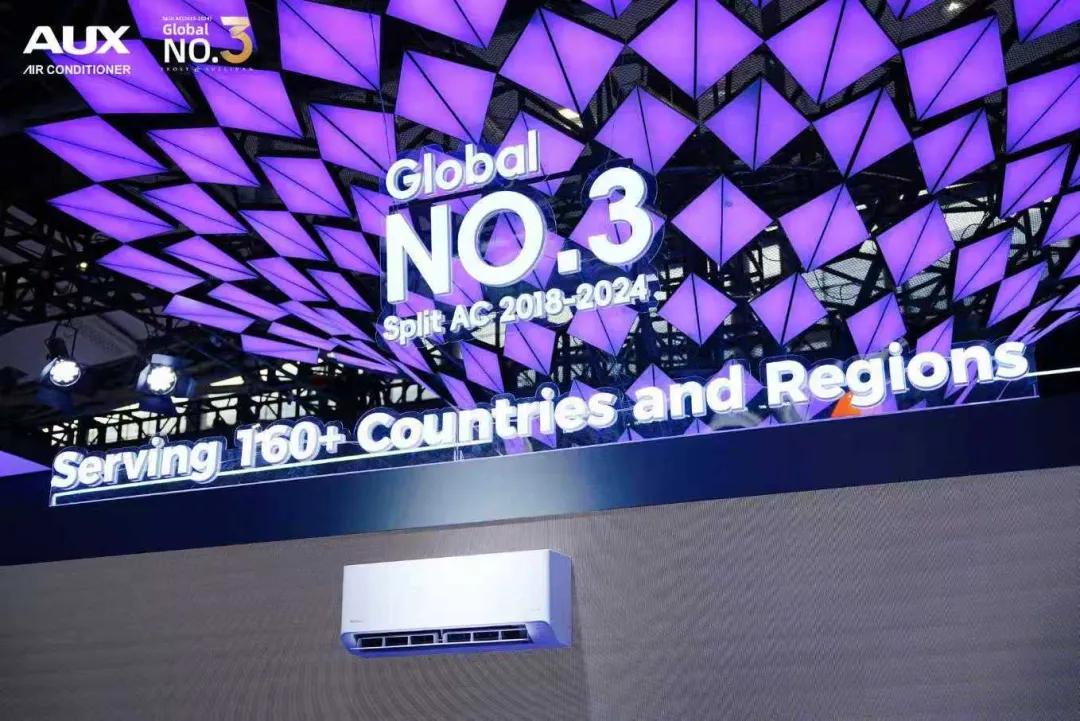
Extreme heat continues to sweep across many European countries, triggering a surge in demand for cooling solutions and sparking a frenzy of purchases in the air conditioner market. Among them, AUX air conditioners have taken the lead in growth, emerging as one of the biggest winners. According to the latest data from Industry Online, from January to May 2026, AUX saw a year-over-year increase of 144% in sales of split-type and portable air conditioners across four Western European countries (Italy, the Netherlands, France, and Spain). Aux portable air conditioners on JD.com’s overseas platform, JOYBUY, have sold out multiple times, and demand through overseas online channels continues to rise.
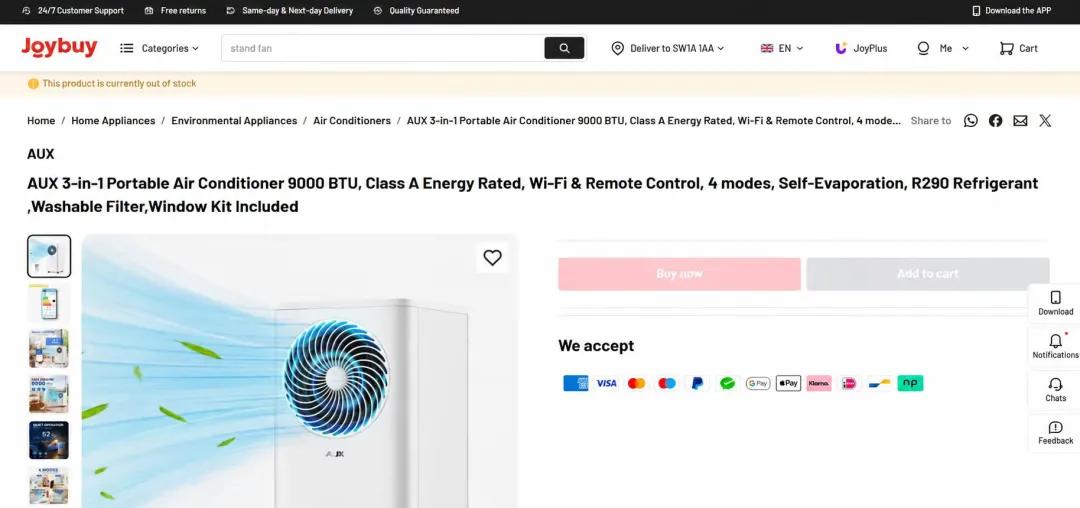
Aux Portable Air Conditioners Sell Out on JD.com’s Joybuy Website
Competition in the European air conditioner market has intensified, with Chinese and international giants competing head-to-head. Why has Aux Air Conditioners been able to maintain its lead and achieve superior growth? The Home Appliance Circle believes that the key to AUX Air Conditioners’ impressive performance—doubling its market share in Europe and ranking among the top three globally—lies not in price competition, but in a fully implemented “localized product innovation + localized service” dual-drive strategy. In addition, a mature, advanced, and comprehensive global operational system has laid a solid foundation for AUX Air Conditioners’ long-term overseas growth.
Deeply Rooted in the European Market: Dual Drivers of Product and Service Build a Differentiated Competitive Advantage
Currently, the European air conditioning market offers enormous growth potential while harboring unavoidable industry pain points, creating a unique market environment.
On the one hand, household penetration rates for air conditioning remain relatively low in major European countries such as France, the United Kingdom, and Germany. The vast demand for retrofitting existing housing stock has yet to be realized, representing a blue ocean market with immense potential; On the other hand, Europe has a massive stock of aging urban buildings, where structural constraints and exterior wall conditions limit air conditioner installation. Compounded by high local labor costs, installation fees can even far exceed the price of the unit itself. The saying “buying an air conditioner is easy, but installing one is hard” has become the biggest bottleneck constraining market penetration—and a major challenge that many air conditioner brands have struggled to overcome.
AUX Air Conditioning, having gained early insight into the current state of the European market and user pain points, abandoned the crude “export-as-is” model of directly exporting domestic models long ago. Instead, it implemented a dual-drive strategy focused on “product localization and innovation” and “deepening localized service,” precisely addressing the core needs of European users and widening the competitive gap with its peers.
On the product front, AUX Air Conditioning has developed a customized product portfolio featuring “super energy efficiency, ultra-quiet operation, rapid cooling and heating, and easy installation” to address three key European needs: “low-carbon policies, residential installation challenges, and significant seasonal temperature fluctuations.”
In terms of energy efficiency, AUX has optimized the unit’s operational logic using its proprietary AI-powered temperature control algorithms and automatic power-restart technology after a power outage. Compared to standard inverter air conditioners, energy consumption is reduced by up to 40%, ensuring full compliance with the stringent energy efficiency certification standards across European countries and aligning with local residents’ low-carbon consumption values. In terms of cooling and heating performance, the frequency modulation logic of the inverter compressor has been optimized to enhance heat exchange efficiency, enabling rapid cooling in summer and quick heating in winter—perfectly suited to Europe’s climate characterized by extreme temperature differences between seasons. Addressing Europe’s extremely strict noise regulations, AUX air conditioners achieve low-noise operation through DC inverter technology, optimized airflow channel design, and AI algorithm control, ensuring silent operation throughout.
To address installation challenges in older buildings, AUX has revolutionized air conditioner design: the PCB board can be directly removed for maintenance, and the indoor unit features a quick-connect, direct-connection modular design. Maintenance and installation can be completed simply by removing the upper cover plate of the unit, saving installers 20 minutes per unit. This significantly lowers labor and installation barriers, resolving the European market’s biggest industry pain point at the hardware level. At the same time, AUX portable air conditioners feature an innovative internal circulation evaporation system that eliminates the need for drainage, sparing users the hassle of frequently emptying water and greatly enhancing convenience.
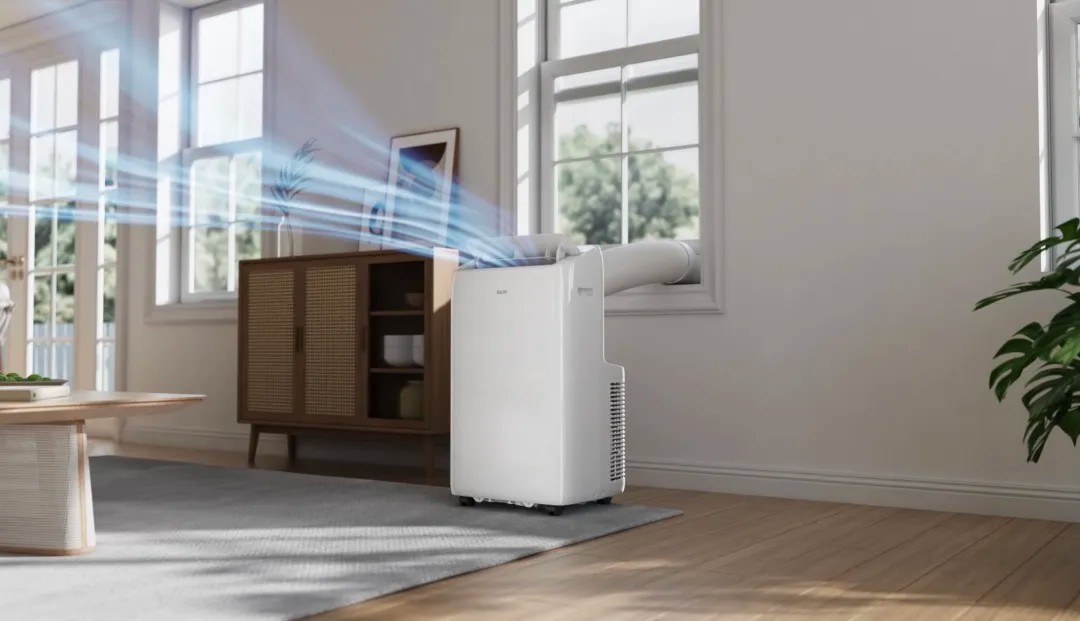
Aux Portable Air Conditioners
In terms of service, Aux has addressed the industry-wide tendency among many home appliance companies to “prioritize sales over after-sales service.” The company has established dedicated, localized installation service teams in key European markets to eliminate issues such as “slow response times” and “inconsistent standards” associated with outsourcing installation to third parties. Facing a surge in orders during the peak summer season, these local teams ensure rapid response throughout the entire process—from order placement to on-site installation. At the same time, they conduct standardized training for engineers to standardize home visit procedures and wall-mounting standards, thereby ensuring service consistency. Currently, AUX has established its own service teams in Italy and Spain—two of Europe’s key markets—to meet the after-sales service needs of multiple neighboring countries.
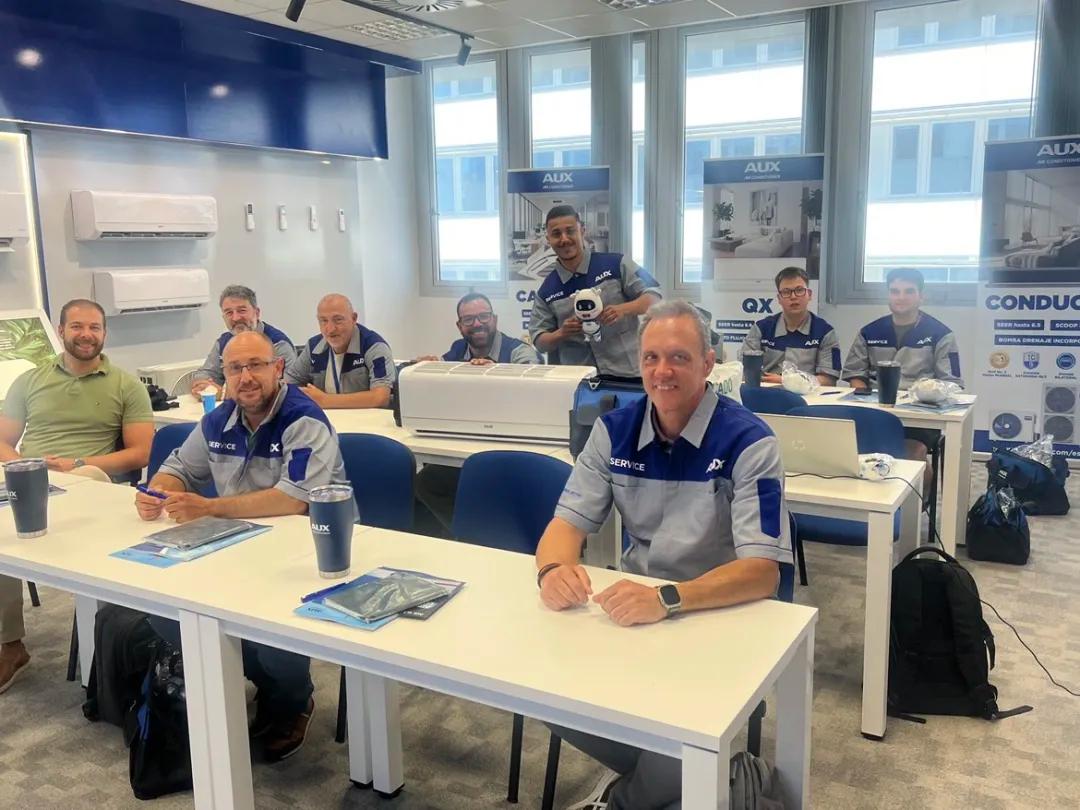
On-Site Training for AUX Air Conditioner Overseas Installation Engineers
The Spanish market serves as a benchmark for AUX Air Conditioner’s service standards, having established a full-cycle, multi-channel after-sales support system: the company has implemented an industry-leading “5-year warranty on the entire unit + 10-year extended warranty on the compressor” program to alleviate customers’ concerns about long-term use; it has independently launched the dedicated AUX Service app, providing one-click access to repair requests, consultations, and self-diagnosis of malfunctions; The company has established forward-deployed warehouses in multiple locations, enabling the rapid dispatch of complete units and core spare parts within as little as 24 hours; complemented by dedicated multilingual service hotlines that address customer needs around the clock, this end-to-end service approach builds a moat of brand reputation.
Three Major Engines of Globalization Drive Simultaneous Growth, Reshaping the Global Air Conditioning Industry Landscape
The impressive performance in the European market is just a snapshot of AUX Air Conditioning’s leadership in global operations. After years of continuous strategic planning and iteration, Aux Air Conditioning has long moved beyond the 1.0 phase—which focused on single-region expansion and product exports—and entered the 2.0 phase, characterized by simultaneous advancement across multiple regions and brand globalization. Its business now spans more than 160 countries and regions worldwide, having established a comprehensive overseas operational system that integrates “product R&D, marketing, channel deployment, and after-sales service.” The company has pioneered “three core engines” to continuously drive global market share growth and reshape the competitive landscape.
Engine 1: Forward-looking, comprehensive market layout to secure a first-mover advantage in global strategy. Unlike many home appliance companies that have merely followed the trend of expanding overseas in recent years, AUX Air Conditioning established globalization as its core development strategy early on. It has long adhered to an overseas business philosophy of “broad coverage and deep roots,” with its business footprint spanning major global markets such as Europe, Southeast Asia, the Middle East, and North America. Long-term tracking data from Frost & Sullivan shows that, leveraging its channel network built up over many years and a stable, well-adapted product portfolio, AUX ranked among the top three globally in cumulative sales of residential split-type air conditioners for seven consecutive years from 2018 to 2024, and led global sales of smart air conditioners for two consecutive years from 2024 to 2025.
As one of China’s earliest air conditioner manufacturers to embark on global expansion, AUX has leveraged the advantages of its full-industry-chain layout—spanning “from core components to finished units”—to establish seven major manufacturing bases worldwide, as well as three global R&D centers in Ningbo, Zhuhai, and Japan. The company focuses on developing customized products tailored to the distinct needs of different markets. By capitalizing on its first-mover advantage, AUX has built a scale advantage that is difficult to replicate in the short term, enabling it to precisely capture the benefits of the global air conditioner market’s widespread adoption.
Engine 2: Transitioning to Globalization 2.0—Refined Operations and Comprehensive Localization. While traditional home appliance companies typically adopt an extensive management model of “remote headquarters control and overseas distribution,” AUX Air Conditioning has taken the lead in upgrading to its Globalization 2.0 strategy, which centers on localizing three core capabilities: “R&D, marketing, and after-sales service.” Currently, AUX Air Conditioning has established sales subsidiaries in 11 countries—including Malaysia, Thailand, the United States, Saudi Arabia, the United Arab Emirates, Spain, Italy, France, Vietnam, Indonesia, and Egypt—to oversee local operations, sales, and after-sales service, ensuring deep alignment with local laws and regulations, consumer habits, and channel rules.
At the same time, AUX Air Conditioning is promoting a “one region, one policy” approach to differentiated services: in Southeast Asian markets such as Malaysia and Thailand, a 10-year compressor warranty has been implemented; in Vietnam, a 365-day “replace-only, no repairs” service has been launched; and in European markets, the focus is on rapid installation and extended unit warranties. Leveraging a network of local service centers across these countries, repair, installation, and parts supply needs can all be addressed locally, resolving the issue of delayed overseas after-sales service at its root.
Engine Three: Transitioning from product globalization to brand globalization, achieving a leap in commercial value. While many home appliance companies still rely on contract manufacturing and low-price, high-volume sales, AUX Air Conditioning has proactively adjusted its overseas structure to vigorously develop its own-brand business. Over the past two years, export revenue from its own-brand products has grown 2.7-fold, demonstrating significant success in this transformation. Currently, overseas revenue accounts for half of AUX Air Conditioning’s total business, becoming a core pillar driving growth.
The confidence behind this leap in its own-brand business stems directly from Aux Air Conditioning’s continuously improving global supply chain system. Overseas manufacturing bases and regional warehousing centers have been established simultaneously, enabling coordination between production and sales and ensuring stable supply. This provides robust production capacity support for the large-scale export of its own-brand products, driving the company’s global expansion strategy from simple commodity trade toward the comprehensive export of technology, standards, and brand value.
In this global competition, AUX Air Conditioning has avoided the homogenized race focused solely on production capacity and low-price competition, instead charting a high-quality globalization path centered on “localization, end-to-end integration, and branding.” By adhering to a demand-driven approach to deep local market engagement, the company has avoided homogenized competition in the global market; by establishing a fully autonomous and controllable end-to-end overseas business ecosystem, it has enhanced market resilience against risks; and by focusing on brand value enhancement, it has led the wave of Chinese air conditioner brands expanding overseas.
From the European high-temperature market